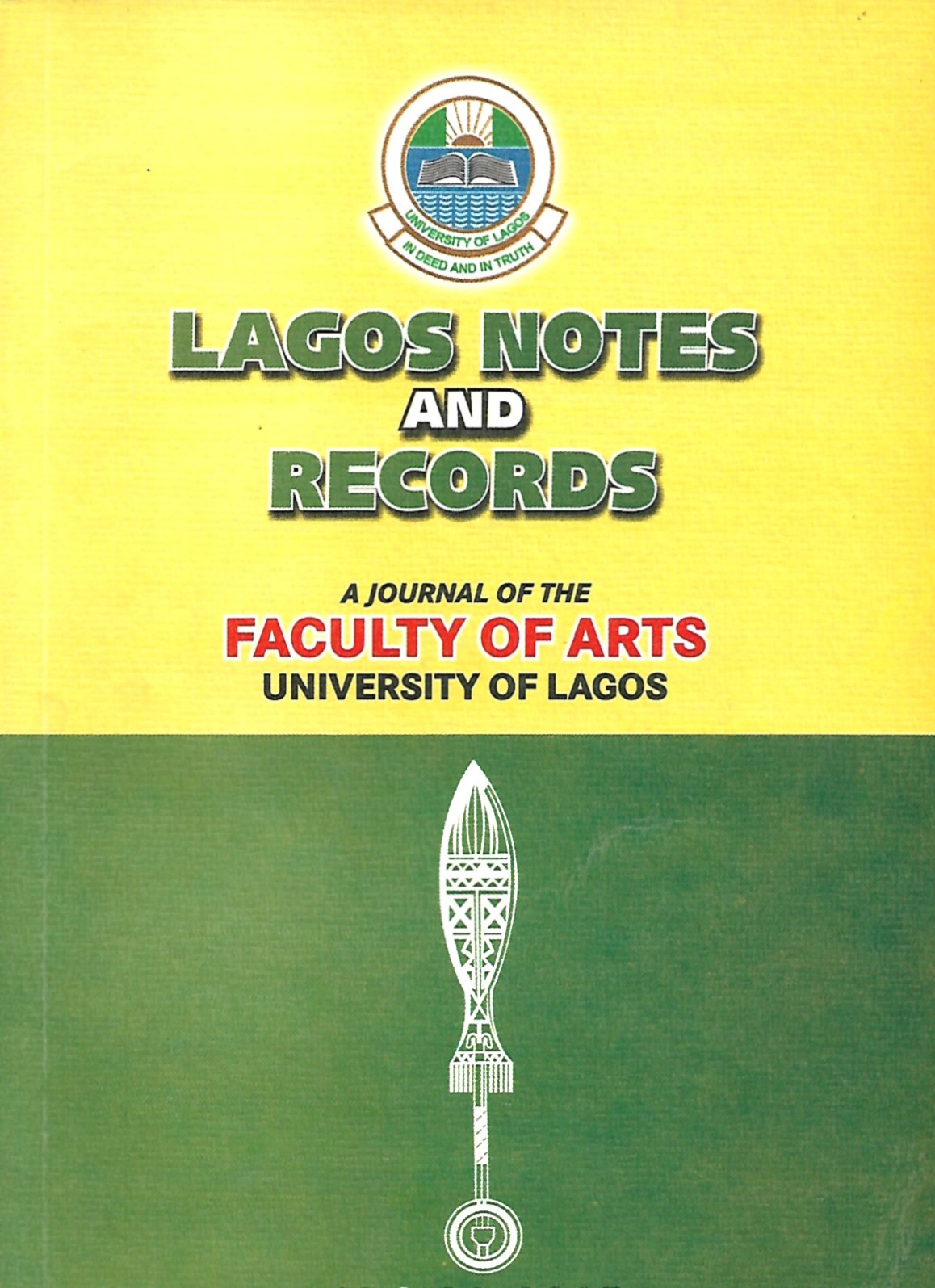
I am delighted to announce the publication of Volume 31, Number 2 (2025) of our esteemed journal, Lagos Notes and Records. The volume comprises ten (10) well-researched scholarly articles representing contemporary thought across various humanities disciplines, with a particular focus on History and Culture, Literature, Creative Arts, Language and Linguistics, and Religion. Each contribution provides a unique perspective on pressing socio-cultural, historical, and economic issues, offering a wealth of knowledge to scholars and the general public alike.
The volume opens with Ayodeji Adedara’s “Appraising Environmental Action in Political Discourse: A Nigerian Gubernatorial Example.” This article explores how a Lagos State governor articulated an ecological vision through public speeches delivered between 2007 and 2015. Utilizing Appraisal Theory and Eco-Critical Discourse Analysis, the study examines how language framed environmental initiatives and economic growth as inherently positive objectives. By analysing text lets from a corpus of 100 speeches—supported by appraisal tables and software concordance—the paper highlights intentional ecocentric language and affirmative lexical choices. It contributes to linguistic appraisal literature by situating environmental communication within a developing-country context, offering insights into how governance discourse consistently valorises growth, development, and environmental responsibility.
The second article, Jamiu Ajiboye Owolabi’s “Aláhoro Factor in the New Ọyọ History,” re-examines the overlooked role of the Aláhoro towns in the foundation of New Òyó. Drawing on oral accounts and archival sources, the author challenges traditional claims of conquest, demonstrating instead that integration was achieved through persuasions facilitated by Aláàfin Àtìbà’s personal ties. The peaceful incorporation of the Aláhoro not only bolstered the population of the new capital but also sustained its economy through farming and hunting. Their distinct status and socio-economic contributions reveal how New Òyó emerged as a strategic consolidation of Òyó heritage, preserving legitimacy while reshaping power in the aftermath of the empire’s collapse.
In the third article, Johnson Fọlọrunṣọ Ilọri challenges the prevailing view of kọ́ as a nominal negation marker in Yoruba. He demonstrates that the scope of kọ́-negation extends beyond isolated focused items to encompass entire focus propositions. By examining entailments and presuppositions of the constructions, the study reveals that kọ́ consistently denies the embedded proposition rather than just the focused constituent. Empirical evidence shows that the constructions presuppose basic propositions from which focus items are extracted, thereby reframing kọ́ as a marker of propositional negation. This insight advances the logical understanding of Yoruba negation and its broader linguistic interpretations.
In the fourth article, “Characterization and Language in Dambudzo Marechera’s The House of Hunger,” Kayọde Kofoworọla explores Marechera’s radical narrative style and fractured protagonists, whose disrupted identities mirror the chaos of postcolonial Zimbabwe. Marechera’s raw language, surreal imagery, and profanity create an uncomfortable honesty as characters emerge as reluctant anti-heroes who are simultaneously victims and rebels. Kofoworọla’s analysis reveals a work that rejects simplistic answers, urging readers to confront the turbulence and alienation of African modernity.
Ikorodu, a coastal community in Yorubaland, is enveloped in a rich tapestry of origin stories and state formation narratives that have long confounded historians. The fifth article, titled “Re-Thinking Traditions of Origin and State Formation in Ikorodu up to 1894” by Charles Omotayo, disentangles these complex accounts to illustrate the community’s historical significance. Through a thorough analysis of oral traditions and historical records, the paper argues that Ikorodu established sophisticated governance structures well before British colonization. The exploration not only challenges prevailing narratives but also fills a critical gap in the historiography of Ikorodu’s past.
The sixth article, written by Sunday Owoade, explores how traditional Yorùbá songs and music transcend entertainment to become potent vehicles for political discourse and cultural identity. Focusing on artists from Ondo, Ìbògùn, and Òyó, the article reveals how performance styles—through rhythm, gesture, and delivery—amplify messages of power, solidarity, and resistance. Owoade’s compelling analysis shows that these performances embody socio-political engagement, uniting community, spirituality, and activism in a vibrant artistic expression that resonates across generations.
The seventh article, “Social Deprivation in Tony Nwaka’s Lords of the Creek and Tanure Ojaide’s The Activist” by Olusola Oso, explores how corruption drives environmental destruction and fuels social crises in Nigeria’s Niger Delta. Using a Marxist lens, the study reveals how the oppressed proletariat faces poverty and ruin while a corrupt elite profits. Environmental mismanagement, class oppression, and government inaction drive the marginalized toward desperate acts, including kidnapping, as a means of redress. The study connects corruption and class struggle to the ongoing cycle of conflict in the region.
In the eighth article, Ayọdele Oyewale examines how Yoruba oral poetry, once deeply rooted in tradition, now faces the pressures of modernity, shifting values, and waning relevance. This article highlights the enduring power of the oral art as a dynamic form that bridges generations, fuels cultural pride, and offers economic opportunities. By tracing its historical roots and examining its reinvention through technology and music, Oyewale reveals how creative youth and artists are reclaiming and revitalizing Yorùbá oral poetry, proving that it remains a living adaptable force within Yorùbá identity and heritage.
The ninth article, “Reflections on Nigeria-Jamaica Diplomatic Relations, 1970–2020” by Faruq Boge and Oluwole Ojo, examines the ties between Nigeria and Jamaica, which are rooted in shared histories of slavery and colonialism. While cultural solidarity and the African Diaspora provide a strong foundation, anticipated economic benefits remain largely unrealized. The study highlights how contemporary relations lack the vigour of earlier times despite promising potential in trade, investment, and tourism. The authors argue that a renewed focus and strategic investment are essential to transform this relationship into a robust political and economic partnership, ensuring both nations fully harness their historical and cultural bonds.
The last article in the volume, though certainly not the least, is Mojisola Shodipe’s “Nollywood Proverbs as Sociolinguistic Expressions”. The study explores the sociolinguistic dimensions of traditional proverbs in Yoruba films, focusing on how they are creatively adapted to represent social practices and their cultural implications. The author demonstrates that Yoruba proverbs are significant rhetorical tools in Nigerian indigenous movies for the projection of unique traditional norms and values. Although typically defined as short, pithy expressions that offer moral advice, proverbs undergo dramatic transformations in modern Yoruba cinema to enhance their sociolinguistic significance, making them more appealing to audiences while fostering a deeper appreciation of ancestral practices.
The articles featured in this volume not only provide new insights into their respective fields but also engage with broader social, cultural, and historical concerns. I, therefore, commend the authors for their scholarly contributions and thank the editors for their diligent work. I am confident that the diverse perspectives presented in the volume will stimulate further research and broaden academic conversations across the humanities and beyond.
Professor Akanbi Mudasiru Ilupeju
Dean, Faculty of Arts
Editor-in-Chief
Published:
2025-12-23